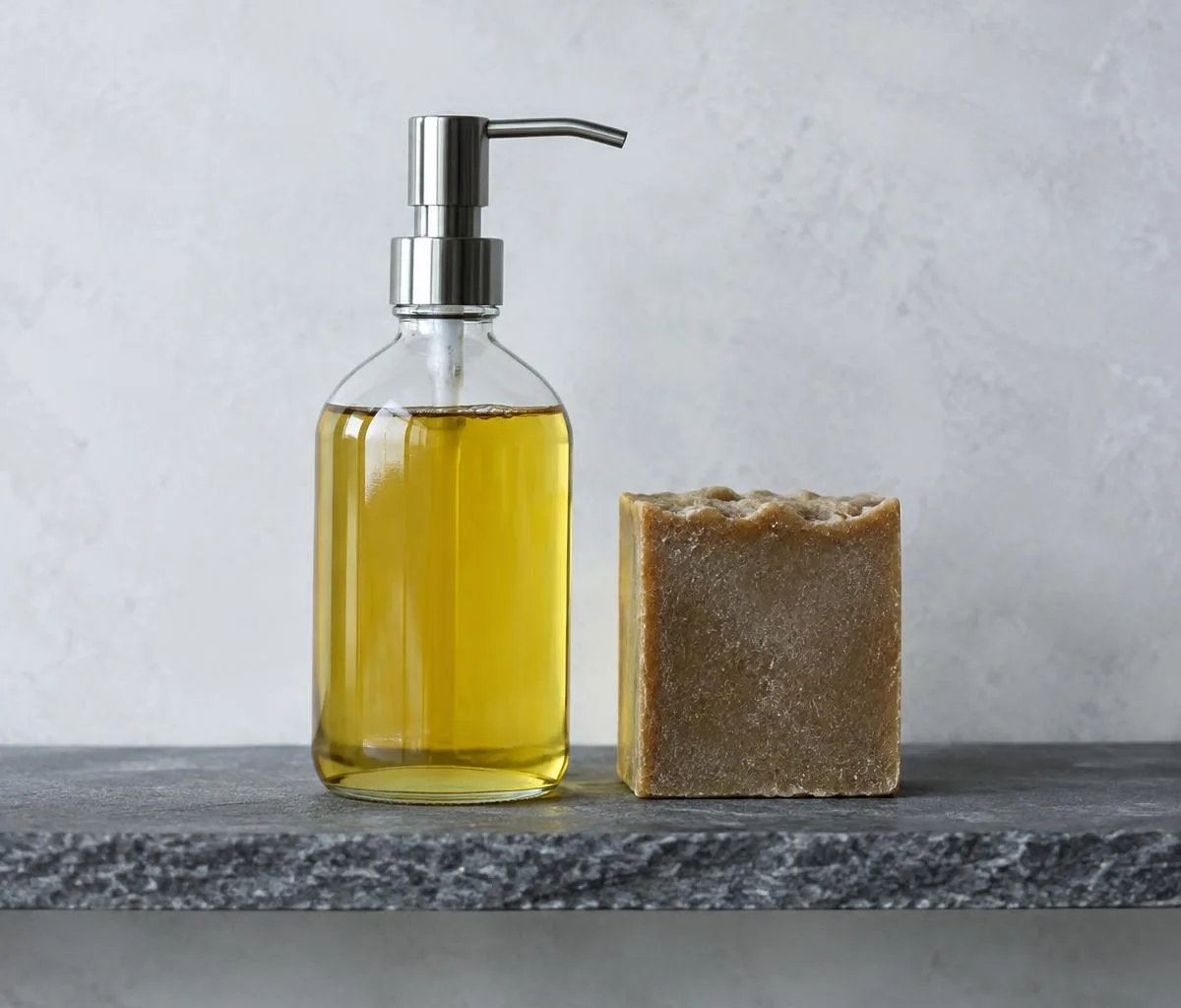
Examine how traditional castile bars compare with synthetic liquid cleansers on cleansing ability, shelf life, and rinse speed. You will be able to choose the right block or bottle based on your local water hardness.
- Saponified bar soaps form curd in hard water but rinse cleanly in soft water.
- Liquid syndet gels maintain an acidic pH that suits sensitive skin barriers.
- Open drainage dishes prevent bar soaps from softening into waste.
On a cold morning along the Canal Saint-Martin, the brass taps in an older flat run shock-cold before clearing into a steady, chalky stream. Most bathroom basins hold either a slick block of cold-process fat drying out on a ceramic ledge, or an amber plastic bottle with a spring-loaded pump. Both promise clean skin, yet they arrive at that point through completely different chemical routes. Between household habits, winter skin irritation, and the gritty ring that hard water leaves on enamel, the choice between a solid bar and a pump bottle is rarely just an aesthetic preference.
Every basin test reveals trade-offs between chemical structure, surface friction, bacterial dwell times, and plumbing maintenance. Looking closely at the soap dish and the pump nozzle settles long-running household debates with measurable facts rather than brand claims. Whether dealing with lime-heavy city water or skin stripped raw by radiator heat, understanding what happens at the water surface changes how you stock your washstand.
How true soap differs from synthetic detergent washes
The fundamental distinction lies in how the cleansing molecule is born. A true bar of soap is an alkali salt of fatty acids. It comes into being when plant triglycerides or animal tallows meet an alkaline hydroxide, usually sodium hydroxide for firm bars or potassium hydroxide for soft pastes. This saponification reaction leaves behind carboxylate salts with an alkaline native pH, typically settling between 9.1 and 10.2. In contrast, liquid body washes, basin gels, and syndet bars are built from synthetic surfactants such as sodium laureth sulfate, cocamidopropyl betaine, or sodium cocoyl isethionate. These compounds are synthesized from petroleum derivatives or fractionated coconut oil, then neutralized to an acidic or neutral pH range between 5.2 and 6.4.
This difference in native pH governs how each wash affects the skin barrier. The stratum corneum maintains an acid mantle hovering near pH 4.7 to 5.5, kept in balance by sebum, sweat, and lactic acid. When a true soap bar touches water, its carboxylate groups require an alkaline environment to stay dissolved; as soon as it meets acidic skin, some of those molecules revert to free fatty acids. That transition provides a brief degreasing wash, but it can also temporarily swell the keratin layers. Synthetic liquid washes remain chemically stable in an acidic solution, which lets formulators match the physiological pH of skin without destabilizing the cleanser itself.
Formulation mechanics also dictate what secondary ingredients end up down the waste pipe. Liquid washes require between 70% and 85% purified water to stay pourable, along with broad-spectrum preservatives like phenoxyethanol or potassium sorbate to stop fungal blooms in the bottle. True soap bars contain almost no free water once cured, holding merely 8% to 14% residual moisture, which makes chemical preservatives unnecessary. The bar stays shelf-stable for years simply because microbial life cannot sustain itself without available water.
| Attribute | True Saponified Bar | Synthetic Detergent Wash |
|---|---|---|
| Active Cleansing Agent | Sodium salts of fatty acids | Synthetic surfactants (anionic, amphoteric) |
| Native pH Range | 9.1 to 10.2 | 5.2 to 6.4 |
| Free Water Content | 8% to 14% | 72% to 86% |
| Preservative Need | None (self-preserving) | Mandatory broad-spectrum antimicrobials |
Interactions between soap lather and municipal calcium deposits
City water drawn from limestone aquifers, like the deep chalk beds feeding northern and central municipal pipes, carries high concentrations of dissolved calcium and magnesium ions. When water hardness reaches 18 to 22 French degrees or higher, a true soap bar behaves very differently in the hand than a surfactant gel. The carboxylate ions of saponified soap have an immediate chemical affinity for bivalent calcium cations. The instant they touch, they precipitate out of solution, forming calcium stearate and calcium palmitate. This is the insoluble film traditionally called lime soap, or bathroom scum.
This precipitate alters both the feel of the wash and the work required to keep the washbasin clean. In hard water, a bar of soap produces a low, creamy lather that feels dense, but a portion of that lather curdles into micro-flakes that cling to enamel, ceramic, and the skin itself. On skin, these precipitated salts can leave an astringent, squeaky drag that many mistake for absolute cleanliness, when it is actually an insoluble coating that traps sebum beneath it. On basin surfaces, it creates a dull matte film that demands regular scrubbing with mild citric acid or vinegar to dissolve the calcium bond.
Synthetic detergents bypass this reaction completely. Sulfonated and ethoxylated surfactants are structured with polar heads that remain soluble even when surrounded by calcium and magnesium ions. They generate a voluminous foam regardless of water hardness and rinse away cleanly through the drain trap without binding to the porcelain. For homes plumbed with raw municipal water and fitted with porous stone or unlacquered metal basins, liquid washes reduce lime scaling noticeably over the course of a single winter.
Bacterial colonization risks on wet soap surfaces versus pump nozzles
Fears over bacteria multiplying on a damp bar of soap date back decades, but the microbiology of the basin shows a distinct division between transient presence and actual infection risk. A bar of soap resting in a flooded ceramic tray will harbor microorganisms on its soft, hydrated outer gel layer, known as the slub. Environmental bacteria like Pseudomonas aeruginosa and common skin flora like Staphylococcus epidermidis can survive in that humid film for several days. However, multiple clinical basin studies demonstrate that while bacteria can sit on a moist bar, they do not easily transfer to the next user in quantities capable of causing colonisation, provided the wash includes a running water rinse.
Liquid dispensers avoid surface slub, but they introduce mechanical collection points that are rarely scrubbed. The interior of the pump spout, the threaded neck of the bottle, and the thumb-actuator are prime sites for biofilm formation. Every time a dirty hand presses down on a pump head before washing, it deposits skin cells, transient microbes, and grease onto the pump's spring housing. In steamy bathrooms, opportunistic molds and bacteria thrive inside the humid nozzle tip where ambient air meets dilute cleanser residue.
Managing hygiene comes down to drainage design and cleaning frequency rather than choosing one format blindly. A bar kept dry between uses is exceptionally inhospitable to bacteria, while a neglected pump bottle can become a contaminated fixture in the corner of the basin.
- Slotted soap perches: Use dishes with raised wooden ribs, wire grids, or sloped draining spouts. When the contact area is under 15%, the bar surface dries within 40 minutes, dropping bacterial counts to near zero.
- Nozzle clearance: Unscrew pump mechanisms monthly, soak the dip tube and cap in warm water with a dash of white vinegar, and pump the solution through to clear dried surfactant plugs.
- Pre-wash bar rinse: Hold a wet bar under running water for two seconds before rubbing it between palms. This simple friction step washes away the outer layer of slub where transient bacteria reside.
- Avoid refilling half-empty bottles: Topping off a half-drained liquid bottle introduces spores into an aged preservative system. Always run the bottle completely empty, rinse it thoroughly, dry it, and then refill it.
Cost per wash and packaging waste over twelve months
Running the arithmetic on basin cleansing reveals massive differences in both raw materials and household spending. A standard 150-gram bar of cured vegetable soap delivers between 110 and 130 hand washes when allowed to dry properly between uses. That works out to roughly 1.2 to 1.4 grams of product per session. A single depression of a typical lotion pump releases between 1.5 and 2.2 milliliters of liquid wash, though people often pump twice out of habit, discharging upwards of 3.5 milliliters for a single basin wash.
Over twelve months, a two-person flat using the basin ten times combined each day will tally 3,650 washes. Meeting that demand with bar soap requires approximately 28 to 33 bars, totaling around 4.5 kilograms of dry matter, packaged mostly in thin paper wrappers or unbleached cardboard that breaks down readily. Meeting that same annual demand with pump bottles consumes between 6.5 and 9.0 liters of liquid. That volume translates into roughly 18 to 24 rigid polyethylene terephthalate (PET) bottles, complete with mixed-material pump mechanisms containing steel springs and polypropylene housings that local recycling facilities routinely reject.
| Factor (3,650 Annual Washes) | Solid Bar Soap | Liquid Pump Wash |
|---|---|---|
| Product Consumed by Weight | 4.5 to 5.1 kg | 7.3 to 9.2 kg (mostly water) |
| Primary Packaging Waste | 28 to 33 paper wraps (approx. 120 g) | 18 to 24 composite pump bottles (approx. 950 g) |
| Average Product Cost per Year | Moderate to Low | Two to Three Times Higher |
| Transport Weight Burden | Light, concentrated solid | Heavy, diluted water mass |
Buying bulk liquid refills reduces plastic waste by roughly 65% compared to purchasing new pump bottles every month, yet it still requires transporting liters of water across delivery networks to arrive at a basin already connected to municipal plumbing. The bar remains unmatched in logistical efficiency because the consumer provides the water from the tap rather than paying a supplier to ship it in a jug.
Choosing between bars and gels according to skin sensitivity
Skin tolerance depends heavily on the state of the skin barrier and the environmental stresses of the season. In the dead of January, when indoor radiators bake the air dry and outdoor winds strip facial lipids, true soap bars can accelerate trans-epidermal water loss. The elevated pH of saponified fatty acids temporarily disrupts the stratum corneum's enzymatic repair cycle, which functions best at an acidic pH. For individuals dealing with diagnosed atopic dermatitis, eczema, or severe xerosis, this alkaline shift can provoke stinging, tightness, and redness.
In those specific cases of compromised barrier function, an unfragranced, weakly acidic syndet wash or non-soap gel is the sounder choice. These formulations clean with milder surfactants that lift lipids without binding aggressively to structural keratin. Look for products built on decyl glucoside, sodium cocoyl glutamate, or disodium laureth sulfosuccinate, which leave the natural lipid matrix largely intact. If symptoms persist or flare into cracked, bleeding fissures, a dermatologist should be consulted to rule out contact allergies or secondary microbial infections.
Conversely, for normal, oily, or resilient skin, a well-cured, superfatted soap bar provides clean performance without modern synthetics. Superfatted bars contain between 4% and 8% unreacted oils, such as olive, shea, or sweet almond, left intentionally free during the saponification calculation. As the carboxylate salts lift grease, these unbonded plant lipids deposit a thin, protective conditioning layer back onto the skin. The result is a clean feeling that rinses away quickly without the slippery, coated sensation that certain polymer-thickened gels leave behind in soft water.
Common mistakes
- Leaving bars in flat-bottomed dishes: Letting a bar sit in a pool of water turns half the soap into useless mush within three days, doubling product waste and encouraging bacterial slub.
- Over-pumping liquid wash: Depressing a pump completely dispenses more surfactant than required for soil removal, requiring excess rinse water to clear the residue.
- Using true soap on acute dermatitis: Applying high-pH alkaline bars to active eczema plaques impairs natural barrier recovery; consult a medical specialist when skin is broken or inflamed.
- Neglecting hard water plumbing build-up: Pairing an alkaline bar with 25-degree chalk water without regularly descaling the sink drain leads to narrowed waste pipes from accumulated lime soap.
- Throwing out soap scraps: Tossing away the thin sliver at the end of a bar discards roughly 8% of the product; press the wet sliver onto the spine of a fresh bar to fuse them together.
Basin set-up and practical next steps
To put these observations to work at your own washstand, take an afternoon to audit your water supply and basin habits. Start by checking your local municipal water report for calcium carbonate levels. If your local supply is soft to moderately hard (under 15 French degrees), a traditional superfatted bar will perform admirably, yielding thick foam without leaving a gritty film on enamel. If your water is extremely hard, balance your preferences: use a bar if you prefer zero packaging waste, but keep a spray bottle of 5% citric acid solution nearby to clear the lime ring weekly.
Next, inspect your hardware. If you rely on bar soap, discard solid ceramic trays and replace them with an open-slatted soap bridge made of oiled beechwood, stainless steel wire, or porous diatomaceous earth. Ensure air circulates beneath the bar so it support firm between hand washes. If you prefer liquid washes for convenience or skin sensitivity, switch to a permanent glass or ceramic pump dispenser. Buy your cleanser in large-format refill pouches or bulk flagons, clean the pump mechanism thoroughly between refills, and train your hand to press the pump halfway down. A controlled basin routine saves money, eases pressure on water treatment systems, and keeps your skin calm throughout the changing seasons.
This publication provides educational reporting only: consult a board-certified dermatologist or municipal health officer for persistent skin conditions. Disclaimer