Learn how sebum, dead skin flakes, and outdoor exhaust coat the scalp during long work weeks. You will find out how to maintain scalp comfort with simple water rinses and gentle mechanical brushing.
- Scalp skin resembles facial skin and produces sebum continuously.
- Daily dry brushing with clean bristles redistributes oils away from the roots.
- A warm water rinse without shampoo clears water-soluble sweat without drying hair shafts.
When the damp cold settles over the city in November, our morning habits shift without much ceremony. We pull thick ribbed knit beanies low over our ears before descending into the warm draft of the metro stations, and we pull them off the moment we reach an overheated office radiator. By evening, the hair roots tell the story of this constant swinging between freezing rain outside and dry radiator air inside. They feel heavy, slightly flattened, and damp at the base, long before the scheduled wash day arrives.
The scalp is skin first and foremost, continuous with the forehead and the nape of the neck. Yet modern hair routines tend to treat it as an all-or-nothing proposition: either thoroughly stripped with foaming cleansers or left entirely untouched under dry shampoos. Finding a steady balance requires looking at what actually collects at the roots between washes: lipid secretions, shed keratin cells, sweat salts, and soot from the street. Managing this buildup does not demand daily shampooing, but it does require an active intermediate routine that respects the biological barrier of the head.
The anatomy of scalp sebum production under woolen winter hats
The human scalp contains between 200 and 500 sebaceous glands per square centimeter, concentrated heavily around the crown and the frontal hairline. These glands release sebum, a lipid mixture composed of squalene, wax esters, triglycerides, and free fatty acids. Sebum serves an essential protective purpose: it coats the hair shaft, limits moisture loss from the stratum corneum, and maintains an acidic surface mantle around pH 4.5 to 5.5. Under open-air conditions, this lipid film migrates down the first few millimeters of the hair shaft naturally as your head moves against collars and pillows.
When you pack the scalp under a thick wool beret or an acrylic beanie for an hour-long commute, the microclimate changes rapidly. The hat traps thermal energy, raising surface temperature by several degrees while retaining the insensible perspiration that evaporates from the eccrine glands. This combination of heat and relative humidity softens the lipid film. Sebum liquefies, spreading rapidly across the scalp surface rather than dispersing down the fiber. At the same time, the friction of coarse wool fibers against the cuticle stimulates local cutaneous nerve endings, prompting mild reflex vasodilation that keeps sebaceous output high.
This trapped environment also changes the behavior of the skin microbiome. Species like Malassezia restricta and Malassezia globosa, lipid-dependent yeasts that live naturally on human skin, consume the triglycerides present in the pooled sebum. They break these fats down into irritating free fatty acids, notably oleic acid. When locked against the scalp under a knit cap for hours, these fatty acids penetrate the upper layers of the epidermis, triggering subclinical inflammation, itching, and an uneven shedding of skin cells before you even step back through your front door.
Why over-washing causes irritation while under-washing causes follicle congestion
The temptation to wash hair every morning often arises from the discomfort of this trapped moisture. However, relying on surfactant cleansers every twenty-four hours creates an unsustainable cycle of depletion. Standard shampoos use anionic detergents to emulsify lipids so that water can rinse them away. When used too frequently on skin that has not accumulated substantial oil, these surfactants strip away not only surface sebum but also the intercellular lipids (ceramides and cholesterol) that bind the stratum corneum together. The skin barrier becomes permeable, leading to trans-epidermal water loss, tightness across the crown, and reactive erythema.
On the opposite end of the spectrum, extending intervals to seven or eight days without any mechanical or thermal cleansing invites follicular congestion. Sebaceous glands do not stop producing lipids simply because a wash is skipped. As sebum pools in the infundibulum (the funnel-shaped opening of the hair follicle), it mixes with shedding corneocytes and environmental particulate matter. Over days, this mixture oxidizes upon exposure to ambient air, changing color from translucent to a cloudy, yellowish paste. This oxidized plug can foster perifollicular inflammation, manifesting as tender red bumps around individual hairs, commonly mistaken for simple acne.
| Condition | Primary Root Cause | Physical Signs at the Scalp | Recommended Corrective Action |
|---|---|---|---|
| Surfactant Stripping | Daily or twice-daily use of foaming detergents | Pinkness, tight sensation, fine powdery white dust, itchiness within an hour of drying | Extend shampoo intervals to 48 or 72 hours; insert mechanical water rinses |
| Follicular Congestion | Prolonged dormancy between washes without brushing or rinsing | Greasy sheen, tender folicular papules, sour lipid odor, hair clumping at the root | Introduce targeted bristle brushing and mid-week warm water rinses |
| Microbial Imbalance | Unmanaged sebum oxidation feeding resident yeast species | Clumpy yellow flakes adherent to skin, persistent itch, diffused pink patches | Consult a dermatologist for targeted antifungal lotions or mild keratolytics |
The goal is to maintain a baseline of clean sebum without letting it turn rancid. A practical baseline for most urban dwellers is a full wash every three to four days, paired with deliberate physical intervention on the days in between. This cadence preserves the epidermal barrier while preventing the buildup that interferes with normal follicular respiration.
The role of mechanical brushing in clearing airborne particles
Long before commercial shampoos were bottled in plastic, daily hair care relied almost entirely on mechanical displacement. In a city where diesel exhaust, construction dust from old limestone facades, and kitchen fumes settle on exposed coats and hair, mechanical clearing remains an effective, overlooked tool. A brush does not merely untangle lengths; it acts as a manual broom for the scalp bed.
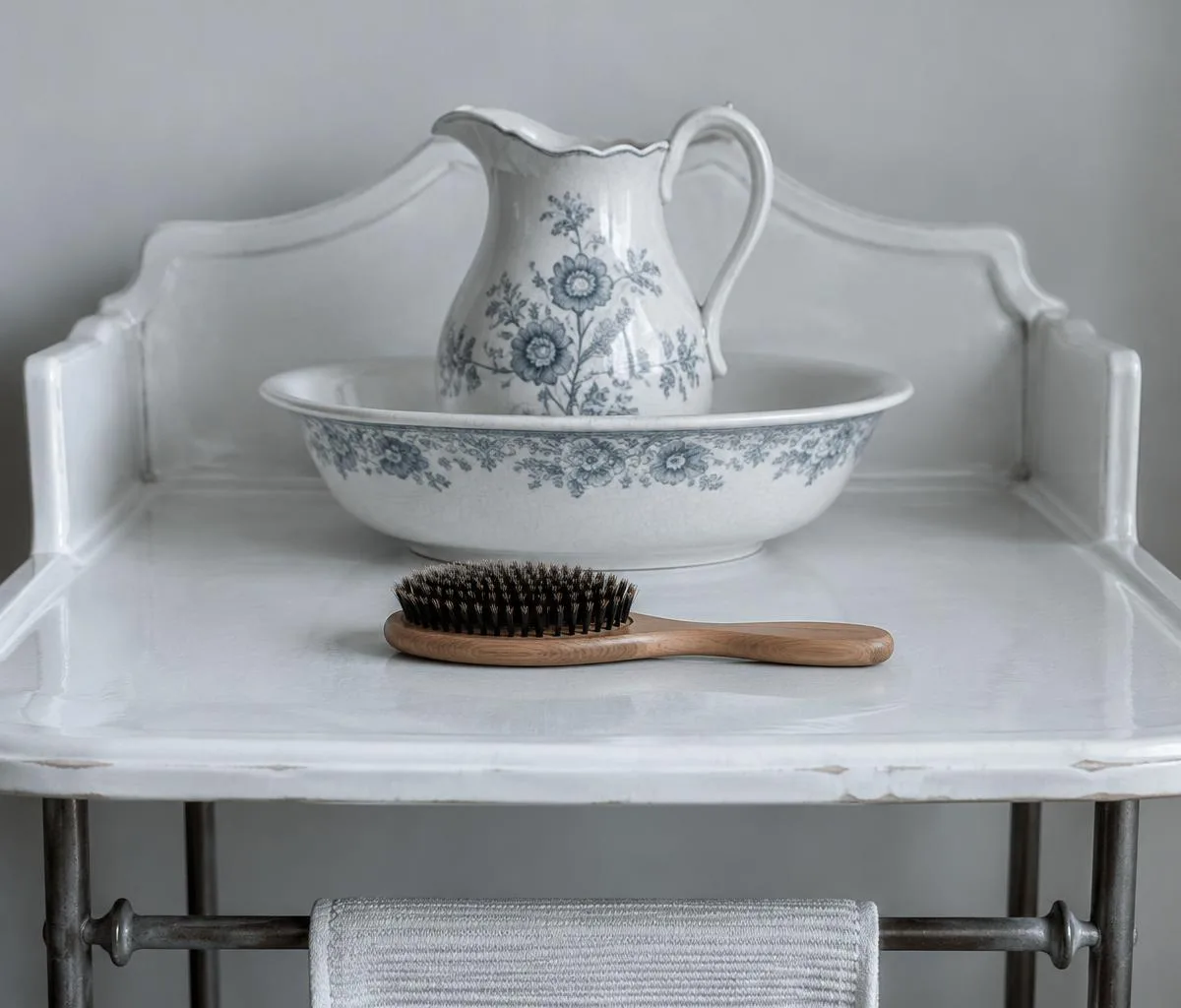
To clear the scalp without causing mechanical traction damage, you need the right tool. A brush with natural boar bristles, or high-grade flexible nylon pins set into a soft pneumatic rubber cushion, provides the necessary density. The bristles must be stiff enough to part the hair and touch the skin without scratching it. Wide-tooth plastic combs cannot perform this function, as their tines are too far apart to catch microscopic particulates or lift lipid crusts.
Follow a systematic method twice daily, preferably in the morning before leaving the house and in the evening before sleeping:
- Detangle the ends of the hair first while standing upright, working through the bottom 10 centimeters with gentle downward strokes to clear knots without pulling on the roots.
- Bend forward at the waist, allowing the weight of the hair to fall toward the floor. This reverses the habitual angle of the follicles and exposes the skin of the nape and occiput.
- Place the bristle tips flat against the skin at the base of the neck. Draw the brush forward toward the hairline with slow, deliberate strokes of moderate pressure. Repeat this across the entire width of the neck for 15 to 20 passes.
- Stand upright, section the hair along your natural part, and brush from the crown outward toward the temples, keeping the bristles in direct contact with the scalp.
- Wipe the bristles of your brush with a clean, dry cotton towel after every session to remove collected soot and sebum, and wash the brush once a week in lukewarm water with mild soap.
This physical movement distributes the sebum down the first 4 to 6 centimeters of the hair fibers, where lipids are actually needed to lubricate the cuticular scales. It leaves the scalp surface comparatively dry and aerated, drastically cutting down the greasy appearance at the part without introducing water or detergent.
Using plain warm water as an intermediate rinse between shampoo days
Many people assume that getting the hair wet requires using shampoo. Yet plain water, applied with physical manipulation and appropriate thermal energy, dissolves sweat salts and dislodges loose particulates without touching the underlying lipid matrix. Sweat contains sodium chloride, potassium salts, lactic acid, and small amounts of urea. These compounds are entirely water-soluble. They do not require chemical surfactants to rinse away; they merely require water volume and gentle friction.
The water temperature must be moderated carefully. Cold water will not soften hardened sebum or rinse away sweat efficiently. Scalding water, on the other hand, strips protective surface fats, triggers peripheral vasodilation, and can stimulate sebaceous rebound. The water should feel comfortably lukewarm, between 36 and 38 degrees Celsius, roughly matching standard body temperature.
To execute an effective intermediate water rinse on day two or three between washes:
- Step into the shower and saturate the hair thoroughly for 90 seconds. Do not rush this wetting period; the water must fully penetrate the inner layers near the scalp.
- Using the pads of your four fingers (never your fingernails), begin massaging the scalp in small circular motions. Start above the ears and work upward to the vertex.
- Focus attention on the occipital ridge at the back of the skull, where heat and sweat pool during sleep. Apply steady, moderate pressure to dislodge loose squames and saline crusts.
- Keep the water running directly over the areas being massaged so the dislodged matter is flushed down the drain rather than settling on lower hair sections.
- After three minutes of systematic massage, squeeze excess water out with your hands. Press a flat-weave linen or microfiber towel against the roots to blot moisture without roughing the hair cuticle.
Once finished, dry the scalp immediately with a blow dryer set to the cool or warm air setting, held at least 15 centimeters from the skin. Leaving the root area to air dry damp in a cold room creates a humid microclimate that encourages yeast overgrowth, undoing the benefits of the rinse.
Spotting the difference between an oily scalp and simple dry flaking
When white specks appear on a dark navy coat collar, the instinctive reaction is to buy an aggressive anti-dandruff shampoo. Yet in the middle of winter, those flakes are frequently caused by dehydration rather than microbial dandruff. Misdiagnosing your scalp condition leads to treatments that make the underlying problem worse. Using zinc pyrithione or selenium sulfide on an already parched, dehydrated scalp accelerates barrier breakdown, leading to cracked skin and burning sensations.
Dry flaking results from environmental desiccation. Central heating drops indoor humidity to low levels, pulling water from the upper layers of the epidermis. The skin cells shrink, detach prematurely, and shed as tiny, dry, translucent particles that flutter down like fine powder when the hair is ruffled. The underlying scalp typically looks pale, slightly matte, and feels uncomfortably tight when you raise your eyebrows or move your forehead.
| Characteristic | Dry Scalp Flaking | Seborrheic / Oily Flaking |
|---|---|---|
| Flake Texture | Tiny, dry, powdery, translucent or white | Larger, thicker, greasy, yellowish or waxy |
| Adhesion to Scalp | Falls freely onto clothing with movement | Clumps in patches; sticks to hair base and skin |
| Sensory Feeling | General skin tightness, localized stinging | Deep, persistent itch, occasional tenderness |
| Scalp Appearance | Dull, dry, occasional faint pinkness | Shiny, coated in lipid film, distinct red spots |
| Aggravating Factors | Low indoor humidity, hot showers, wind | Stress, trapped sweat under hats, skipped washes |
True seborrheic flaking involves excess lipid production coupled with an inflammatory reaction to yeast metabolites. These flakes are larger, yellowish, and greasy to the touch. They rarely fall freely onto the shoulders; instead, they remain plastered against the scalp, forming crust-like plaques around the hair follicles. If you scratch the area, the material under your fingernail feels soft and buttery. If your scalp displays these thick, adherent plaques alongside widespread redness or weeping, schedule a visit with a board-certified dermatologist rather than attempting to scrub the skin raw at home.
Common mistakes
The most frequent error in intermediate scalp maintenance is the habitual, heavy reliance on aerosol dry shampoos. Most dry shampoos use starches, talc, or silica suspended in alcohol and propellants. While these powders absorb surface lipids to dull the shine at your roots, they do not remove anything from your head. Instead, they form a thick, drying paste with the existing sebum, sweat salts, and dead skin cells. Left in place for multiple days, this compounded cake clogs the infundibulum, suffocates the follicle entrance, and creates an ideal breeding ground for inflammatory organisms.
Another regular misstep is applying botanical oils directly to an itchy or flaking winter scalp without knowing the underlying cause. Massaging argan, olive, or coconut oil onto a scalp suffering from mild seborrhea provides a feast for resident Malassezia species, which metabolize specific carbon chains in plant oils just as readily as human sebum. This practice turns minor flaking into an active flare-up within forty-eight hours.
Finally, using nails to vigorously scratch the scalp during washes or intermediate rinses creates microscopic lacerations. Pathogens present on the skin surface can enter these tiny breaks, leading to bacterial folliculitis. The fleshy pads of the fingers contain sufficient texture to clear the skin without breaking it.
A realistic weekly rhythm
Adopting a balanced scalp protocol does not require purchasing a shelf full of specialized scrubs and tonics. It simply requires structuring your week around two deliberate wash sessions, supported by non-chemical mechanical clearing on the intermediate days.
- Sunday Evening: Full wash day. Cleanse the scalp with a gentle, sulfate-balanced shampoo, massaging methodically with the pads of the fingers. Rinse completely, condition only the mid-lengths and ends, and blow-dry the roots until thoroughly dry before going to sleep.
- Monday: Mechanical maintenance. Leave the hair dry. Before leaving the house and after returning, spend three minutes brushing inverted from the nape upward, then upright from the hairline backward, using a clean natural bristle brush.
- Tuesday: The intermediate warm rinse. If you have exercised, commuted in a heavy hat, or feel sweat buildup, step into the shower and perform a three-minute lukewarm water rinse without any shampoo. Massage the roots thoroughly, blot with a towel, and dry the scalp immediately with a hairdryer on the cool setting.
- Wednesday: Mechanical clearing. Repeat morning and evening brushing sessions. If your wool hats smell slightly stale, turn them inside out to air near an open window or wash them in a gentle wool bath; worn hats transfer oxidized lipids back onto clean hair within minutes.
- Thursday Evening: Second full wash day. Wash again with your regular shampoo, repeating the Sunday procedure.
- Friday and Saturday: Assess and adapt. Use dry brushing or a brief warm water rinse depending on your activity level and the weather outside. Keep hat interiors clean and avoid applying heavy styling waxes directly to the skin.
If persistent burning, severe scaling that forms hard yellowish crusts, or localized patches of hair shedding occur at any point, stop experimenting with your routine and consult a dermatologist. For the vast majority of winter scalp troubles, however, removing the buildup of the streets and the subways through regular brushing and plain water rinses will keep the skin calm, resilient, and clear until spring returns.
This publication provides educational reporting only: consult a board-certified dermatologist or municipal health officer for persistent skin conditions. Disclaimer